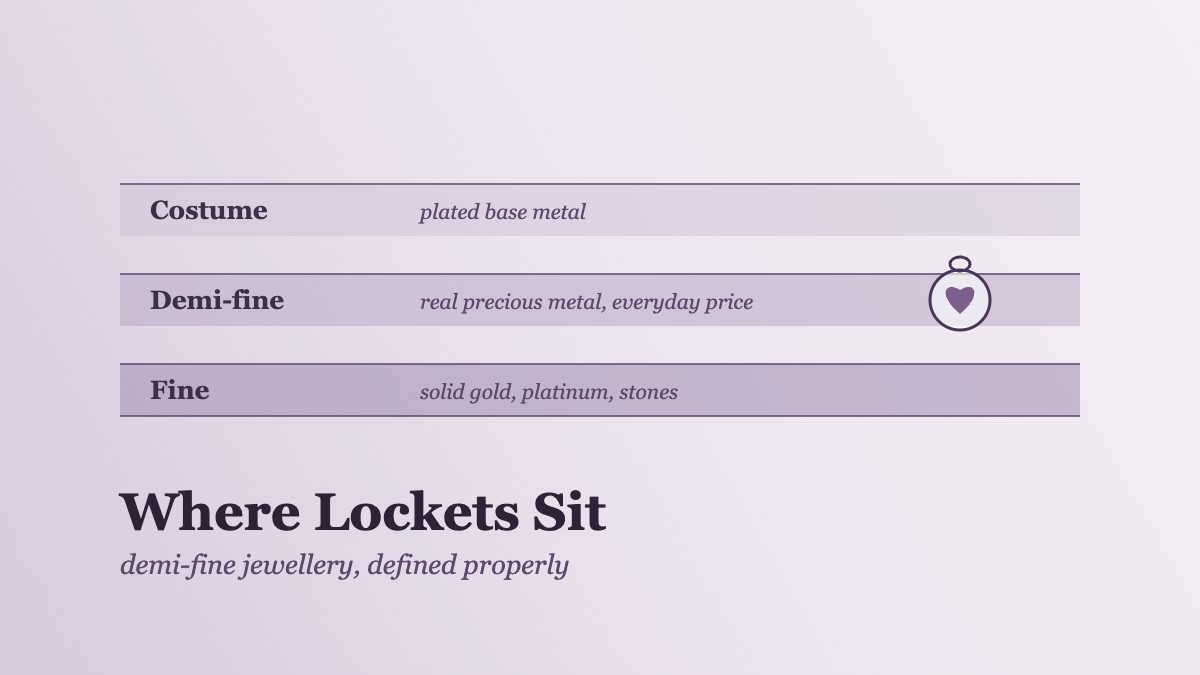
“Demi-fine” is one of those terms that arrived without a definition and has been doing heavy lifting in product copy ever since. It is not a regulated classification. No standards body audits it. That makes it easy to dismiss as marketing, which would be a mistake, because underneath the vagueness there is a real and useful distinction about how a piece is made.
The distinction is about material, not price. Understanding it changes what you look for on a listing, and it explains why certain categories, lockets in particular, sit in this tier so naturally.
Three tiers, described by construction
Costume
Base metal, most often brass or zinc alloy, finished with a thin coating of something that looks precious. The coating is the product. Once it wears through, which on a high-friction piece can be a matter of weeks, there is nothing underneath worth keeping and no repair worth paying for. Costume jewellery is designed for a season, and priced for one.
Fine
Solid precious metal throughout, usually 14k gold and above or platinum, frequently set with precious stones. Fine jewellery can be repaired, resized, re-tipped and remade almost indefinitely, and it has intrinsic metal value independent of design. It is also priced accordingly, which for most people means it is a small number of pieces bought for a small number of occasions.
Demi-fine
The middle tier, and the only one defined by what it refuses to compromise. Demi-fine uses genuine precious metal as the substance of the piece rather than as a surface. In practice that means solid sterling silver, or a substantial layer of gold over a sterling silver base, which is properly called gold vermeil and has a defined minimum thickness.
The critical detail is the base. Vermeil over sterling and gold plating over brass can look identical in a photograph and can carry similar prices, but they are fundamentally different objects. One has a precious metal core; the other has a precious metal skin over something disposable.
The questions that actually sort a piece into a tier
Ignore price, which cuts across all three tiers, and ask instead:
- What is the base metal? Sterling silver puts a piece in demi-fine territory. Brass or unnamed alloy puts it in costume, whatever the price.
- If it is plated, what is the plating and how thick? Vermeil is a defined term. “Gold finish” and “18k gold plated” without a stated base are not.
- Can it be repaired? Soldered sterling can be fixed by any jeweller. A plated base metal piece usually cannot be repaired without destroying the finish.
- Does the listing say any of this? Brands operating genuinely in this tier state it, because the material is the reason for the price. Vagueness is itself an answer.
Why lockets belong in this tier
Most jewellery categories can be executed at any of the three tiers. Lockets are unusual in that they are actively bad at two of them, for reasons of engineering rather than taste.
A locket is a mechanism. It has a hinge that flexes every time it opens and a closure that must hold under pressure. Mechanisms need metal with some structural integrity behind the finish. Plated base metal wears through fastest exactly where the hinge moves and where the two halves meet, so a costume locket develops a visible worn edge and a slack closure within a fairly short life. The failure is functional, not cosmetic: a locket that will not stay shut has stopped being a locket.
A locket is worn constantly. Unlike an occasion piece, it is typically put on and not taken off, which compounds the wear problem and makes skin compatibility non-negotiable.
A locket is a keepsake. The thing inside it means something, which means the object needs to last long enough to justify putting it there. Fine jewellery would do that admirably, but at a price that makes it an heirloom purchase rather than something bought for oneself on an ordinary Tuesday.
That is precisely the gap demi-fine fills: real metal with a real lifespan at a price that permits the piece to be bought casually and worn daily. It is why locket ranges in this tier are noticeably more detailed about construction than costume equivalents, stating base metal and finish rather than describing a colour: https://www.lavanajewellery.com.au/collections/heart-lockets
What demi-fine does not promise
Honesty about the limits is what makes the category credible.
- Vermeil is not permanent. A substantial gold layer over sterling lasts far longer than flash plating, but it is still a layer and it will eventually thin at high-contact points. The consolation is that what is underneath is sterling silver rather than brass, so the piece remains wearable and can often be re-plated.
- Silver tarnishes. This is oxidation, not damage, and it polishes off. It is a maintenance task, not a defect, and anyone selling sterling should say so.
- It is not an investment. Demi-fine has modest intrinsic metal value and should be bought to be worn, not held.
- The term is unregulated. Anyone can print it. The specification underneath it is what matters, which is why the four questions above are worth more than the label.
The practical takeaway
Treat “demi-fine” as a prompt to check the specification rather than as a guarantee of one. A listing that names its base metal, states its plating type, and gives you enough information to predict how the piece will age is telling you it belongs in this tier. A listing that uses the phrase and then declines to say what the thing is made of is using it as decoration.
For a category like lockets, where the object has moving parts and is expected to outlast whatever is sealed inside it, that difference is the whole purchase.
Frequently asked questions
What is the difference between demi-fine and fine jewellery?
Fine jewellery is solid precious metal throughout, typically 14k gold or above or platinum, often set with precious stones. Demi-fine uses genuine precious metal as the substance of the piece, most commonly sterling silver or gold vermeil over a sterling base, at a considerably lower price point.
Is gold vermeil the same as gold plated?
No. Vermeil is a defined term requiring a gold layer of a specified minimum thickness over a sterling silver base. Generic gold plating has no thickness requirement and usually sits over brass or another base metal, so it wears through much faster and leaves nothing worth keeping underneath.
Is demi-fine jewellery worth buying?
For pieces worn frequently it usually represents the best value of the three tiers, because the cost is spread across many wears and the materials tolerate daily contact with skin. For pieces worn only on rare occasions, the durability advantage matters far less.